

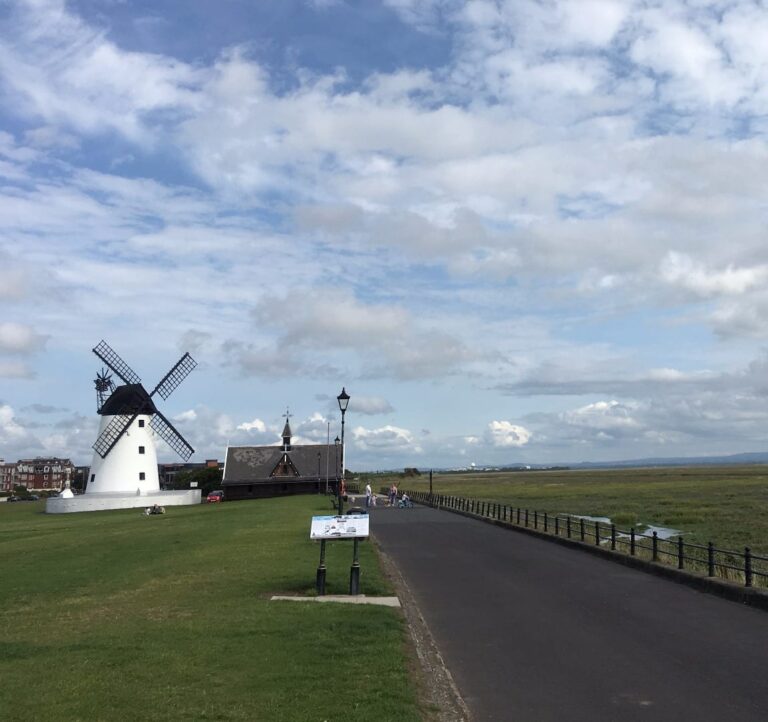
Explore Lytham seafront. Where the freshwater of the River Ribble estuary marshlands meet the saltwater of the Irish Sea is the wide, open space of Lytham Green.

It’s a popular space with local people and visitors, all through the year. Enjoy this walk around the Green and the windmill, on a bright summer day –

It even has a wild, windy beauty in the depth of winter! In sharp contrast, the next video is from a cold and windy day in December…

- If you’ve enjoyed this video, why don’t you subscribe to the Visit Fylde Coast YouTube channel?
In the next photo we’re looking West (right) along the coastline, towards the Irish Sea.

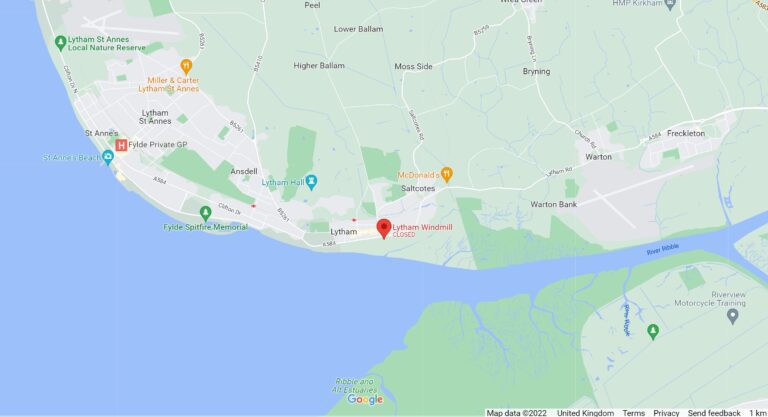
This map shows the position of Lytham seafront where the Irish Sea meets the Ribble Estuary. The pin is at Lytham windmill – the photos on this page were all taken roundabout here.
Lytham Green
The shore in this area was once made entirely of uneven dunes and marsh lands. Over the years, reclaimed land became what we now know as Lytham Green. Beyond the footpath, ornamental railings and the area maintained by man, is the age-old natural landscape of the shore.
FREE Newsletter
FREE Newsletter

It’s a lovely place to enjoy the great outdoors. You’ll see people walking here all through the year, sitting on the grass in summer, picnicking, playing games and enjoying the day.
The Green runs along the full length of the waterfront and provides an open space for special events like Lytham Festival.
Restoring the Slope
In Spring 2022, Lytham Festival organisers Cuffe and Taylor covered the cost of landscaping works to restore the slope to the Green.

Some years ago, sports and recreation pitches were built into the original gradient, creating a ‘step’ in the slope. The step impacted on many activities and regular users so the work will make the site safer for all users as well as improving disability access.
The work began on Wednesday 9th March and included removal of the grass and re-establishing the ground to create a continuous soft gradient.
East Beach
East Beach is the official name of the highway along the seafront promenade. It’s separated from the natural waterfront by the wide, open grassland of Lytham Green. Period architecture and the sympathetic new-build properties here are a very attractive backdrop to the main coast road.

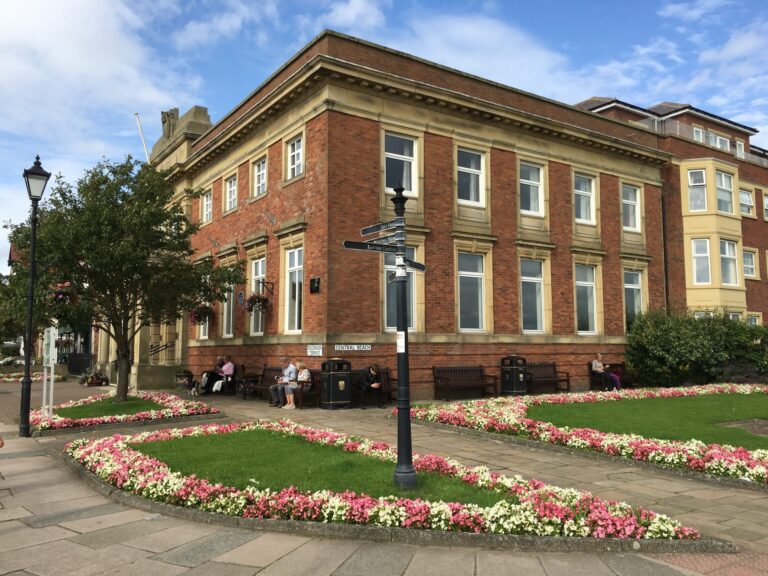
Lytham Assembly Rooms is just one of the notable buildings you’ll see here. It’s yet another interesting building in its own right, home to many a community event. It regularly hosts private parties, markets and craft fairs which you’ll find in the Visit Fylde Coast What’s On guide.
Situated on its attractive corner plot, lawns and pretty borders make up the front garden of the Assembly Rooms. Sit for a while in the sunshine and enjoy the view!
The Windmill on Lytham Seafront
The seafront at Lytham Green is also where you’ll find the famous Lytham Windmill, standing tall on the edge of the shore. This lovely photo is by Tony Eade. Along with the moon, you can see the landscape across the river, silhouetted in the glow!

Thanks to local volunteers you can go inside Lytham Windmill and take a look into a bygone world with the museum inside. Hard to imagine what life must have been like in the heyday of this distinctive building.
The lower building to the side of the windmill, in the foreground of the next photo, is home to the Lifeboat Museum. Inside, on open days, you can explore the history of the local RNLI. You can also see a fully restored original lifeboat.

What’s on Lytham Green
Public car parks at Lytham Green are handy both for seafront walks and visiting the town centre. Clifton Street, the main high street, lies parallel to East Beach. It’s only a short walk from the Green.

On a practical level, there’s a block of Danfo public toilets adjacent to the Windmill. They’re single cubicles, operated by coins.
Lytham RNLI lifeboat has a base on the Green. Why don’t you pop into the shop and see if any of their fabulous range of fundraising gifts takes your fancy? There’s also a much bigger RNLI all weather base at St Annes.

Mussel Tanks
Lytham RNLI is also to the left of the recently restored Mussel Tanks.

The Mussel Tanks date back 1934, originally built to enable fishermen to clean their catch of shellfish. Mussels were landed here from all over this coastline – some from as far away as Morecambe Bay.
Thanks to Lytham St Annes Civic Society, this area has been restored. It’s now an attractive place to stop for a while, where the history of the site is preserved for the future.
Spectacular Views from Lytham Seafront
The view from the edge of Lytham Green looking across the water is amazing on a clear day. You can see right across the estuary of the River Ribble to as far as north Wales.
Southport (bottom left-ish corner) can easily be seen too. It’s one of the built up areas that you’ll see, across the river.

Lytham sits on the turn of the coastline, where the estuary of the River Ribble opens out to sea. Beyond the marshland is a very flat beach and as a consequence there’s a big tidal range. Waters retreating a long way with each low tide and come back in very quickly.
PLEASE don’t go exploring out into the bay – it’s very dangerous and you certainly won’t outrun the sea!
Wildlife on Lytham Seafront
There’s a broad strip of marshy grassland against the hard landscaping of the promenade – and it’s rarely covered by the tide. It’s also an important natural sea defence and margin of safety against high water in bad weather.
Retreating tides leave sediment behind that provides the most magnificent feast for seabirds and waders which come to feed here. Refreshed by the sea twice a day, it’s laden with invertebrates that form a rich diet for resident birds. Thousands of migratory birds also use it as a stop off point on their huge journeys each year.

National Nature Reserve
It’s a perfect habitat for species which inhabit marshlands. Over half of the whole Ribble Estuary is a National Nature Reserve.
The Ribble Estuary is the most important site in the UK for wintering wildfowl. Its extensive mud and sand flats make it one of the largest saltmarsh habitats in the country. More than 250,000 ducks, geese, swans and wading birds visit here each year. It’s also internationally important for 16 species of wintering birds. The best times to see all this is in the months of autumn and winter.
Help the birds
Sea birds that gather at the water’s edge while the tide’s in are trying to conserve vital energy and warmth while their feeding grounds are covered. Please don’t disturb them or let your dog run at them. Making them fly wastes their precious energy when food stocks are scarce.
In summer, the landscape is still active, when birds are nesting on the saltmarshes. Around the Ribble Nature Reserve you might be lucky enough to see three types of gull, common tern and redshank, skylark, meadow pipit and linnet. Natural England manage the land they nest on. Sheep and cattle graze areas of saltmarsh in spring and summer to keep the grass short for the wintering wildfowl. Look hard enough and you may see these birds nesting on the marshes at Lytham.
Church Scar
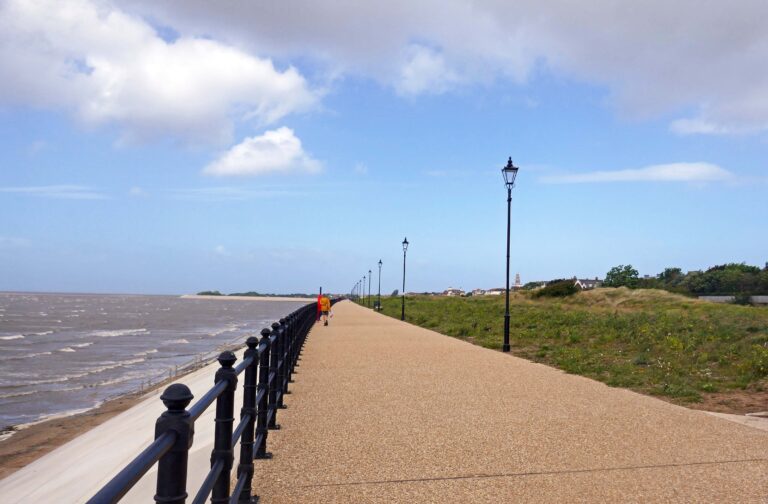
East Beach (the coastal highway) bends away from the shore at Seafield Road just before you get to Clifton Drive. But the coastal footpath carries on at Church Scar, coming out at Granny’s Bay. This new section of seawall opened in 2020. It’s an amazing public space and well worth a look.
Granny’s Bay
East Beach and the seafront part company for a short distance as you head towards St Annes, approaching Clifton Drive. Your next big landmark is the White Church on the corner of Ansdell Road.
Turn left and follow the coastal road at the White Church cross roads. This is Granny’s Bay (below) with Fairhaven Lake ahead.
For walkers, a footpath runs along the water’s edge from Lytham Green to Granny’s Bay. It’s a pleasant stroll against the edge of the sea, watching the wading birds on the sands.

Fairhaven
Heading north beyond Granny’s Bay, before you reach St Annes, the next stop is Fairhaven.

Fairhaven Lake is a popular attraction for people and wildlife alike. Here, you can hire a rowing boat and mess about on the water. Enjoy a bite to eat at the lakeside cafe, or simply walk the footpath around the back of the lake.
Find out more about these areas in our Visit St Annes website.
While you’re here…
Go to the homepage of the Visit Lytham website for the latest updates.
Love the Fylde Coast? Sign up for your email newsletter. Packed full of interesting things it arrives in your inbox all 52 weeks of the year.
Join us on Facebook at our Visit Fylde Coast Facebook Group and follow us on Twitter @visitFyldeCoast
Plus hundreds of videos to watch on our YouTube channel – from all over the Fylde Coast!
Booking a stay? Pick a safe, clean and legal place to stay, at the very best price. Book with the Visit Fylde Coast and StayBlackpool guide.

We Need Your Help
We Need Your Help




I agree with Barry, the signs say that right of way on the green is for the public and that dogs should be kept on a leash but this isn’t happening. I am unable to the green now with my kids because the dogs run up to him.
I would prefer to see café`s and restaurants that bans dogs advertised more as most people I talk to are getting fed up with “dog friendly Britain”. It’s getting out of control, not all dog owners stick to the rules of cleaning up and many times dogs on beaches run wild, the so called owners letting them do as they please. So come on Fylde let us see a more equal share for us the general public!!!!