

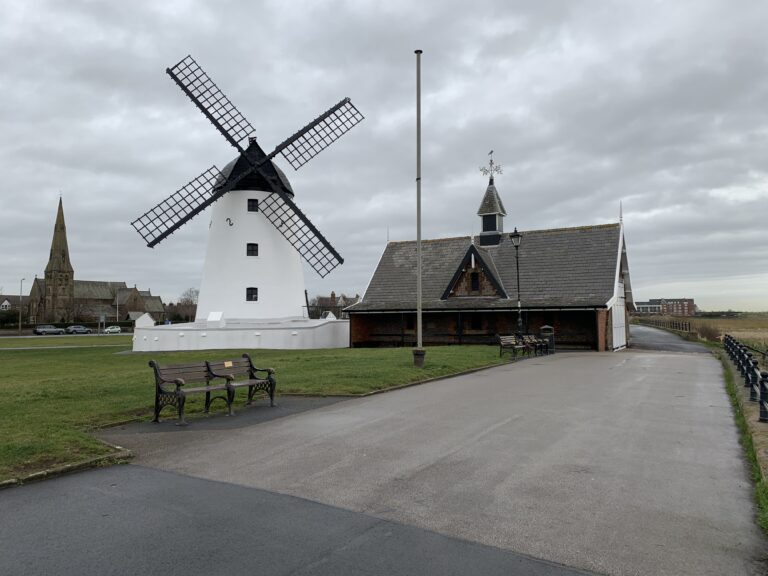
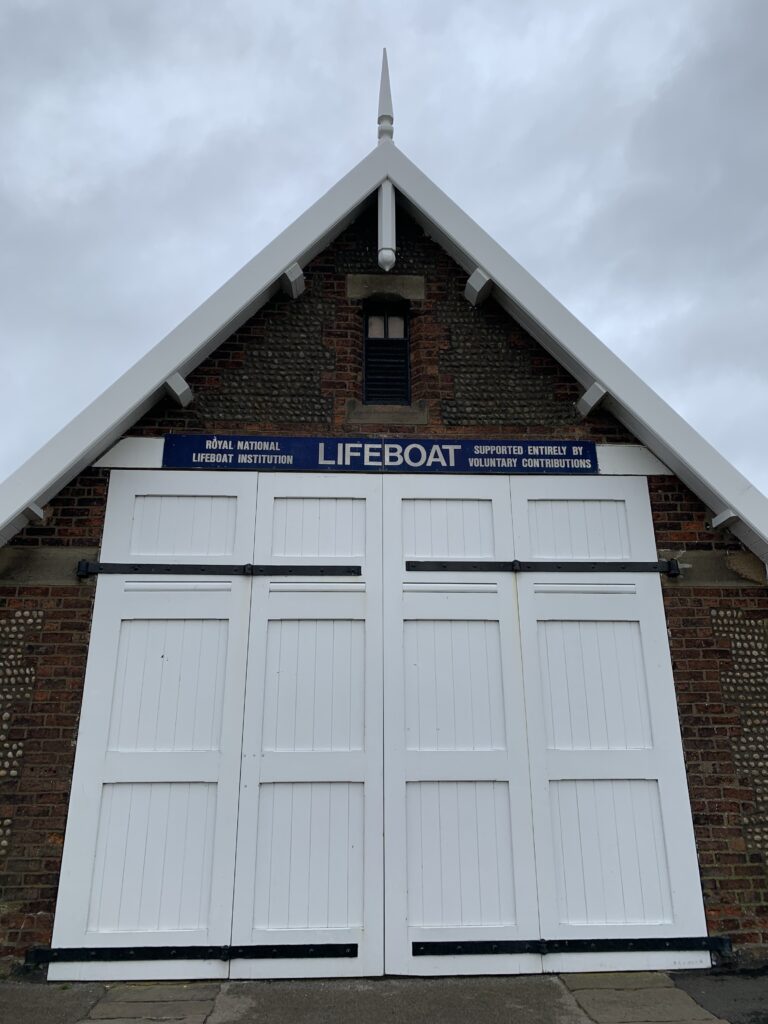
The doors of Lytham Old Lifeboat House and Chapman Lifeboat reopened in autumn 2015 after 10 years of closure. The Chapman had already undergone a period of extensive restoration, before being displayed here in Lytham.
Lytham Old Lifeboat House and Chapman Lifeboat
The building to the seaward side of Lytham Windmill is the Old Lifeboat House. You can take a look inside at weekends when the Windmill is open.

- If you’ve enjoyed this video, why don’t you subscribe to the Visit Fylde Coast YouTube channel?
The old Lifeboat House forms part of the Windmill Museum and displays a full size, 1901 pulling and sailing lifeboat. The Chapman is the first lifeboat in the Old Lifeboat House since 1931 when the Kate Walker was replaced by the JHW.
The Chapman lifeboat has strong links to the north west and is a sister vessel of the St Annes No1 lifeboat ON587 James Scarlet. James Scarlet was on station from 1908 to 1925 and launched 9 times saving 20 lives.
Modern Day Lifeboats
Today, the RNLI maintain a rescue service from their modern lifeboat station at St Annes seafront.
The lifeboat and RNLI is every bit as vital today as it was when the Chapman was in service. It’s funded by the public and you can join in with various events throughout the year. Leg it for Lytham Lifeboats is just one of them.
You’ll see in the video above that there is a small, satellite facility and shop at Lytham. Find it adjacent to the old lifeboat house, near the Windmill.
FREE Newsletter
FREE Newsletter


History of Chapman Lifeboat
ON461 Chapman a Liverpool class pulling and sailing lifeboat was built in 1900 – 01 at Thames Ironworks.
She’s 35 feet long by 10 feet beam, the height to the top of the gun whale is 5 feet and she originally weighed 4.5 tons. She is probably nearer 3.5 tons now.
Built in the era before engines, she was designed to be rowed and sailed by 15 men, 12 oarsmen, a coxswain, second cox’n and bowman. The boat hull is 100% original, Honduran mahogany. Sadly this is no longer available, as all the trees are gone.
Until 1920, Chapman was originally stationed in Groomsport, County Down. When Groomsport closed, Chapman joined the RNLI Reserve and in October 1920 was sent to Cromer, where she was briefly “cox’d” by Henry Blogg, the most famous of all lifeboatmen. Henry was awarded 3 RNLI gold medals, 4 silver medals, the George Medal and British Empire Medal during his 53 years of RNLI service.
In 1924 Chapman was sent to Hilbre Island (above) where she was operated by the Hoylake lifeboat crew. As motor lifeboats succeeded “pulling and sailing” lifeboats and war approached, the Hilbre Island station closed in 1939 and Chapman left Hoylake.
War Effort and Day Trippers
After leaving Hoylake in September 1939, it’s believed that Chapman joined the war effort as a working boat. Stationed on the opposite side of the River Dee estuary, at Point of Air colliery.
The next we know of her is in the early 1950’s. By this time she’s had an engine installed, been re-named Harbinger and is taking day-trippers out into Morecambe Bay.
Harold Gardner, a Lancaster man, and his brother Thomas, bought the Harbinger on 10th March 1956. She was fitted out for piloting in the River Lune estuary by James Nicholson Ltd of Glasson Dock and commissioned for piloting on 16th May that year. Harold and Thomas decided to rename their boat Peggy.
Peggy served as the Lancaster pilot boat for 35 years, being moored off Sunderland Point. On one occasion she resumed her role as a lifeboat, being summoned by Lancashire Police to save 2 men from a capsized dinghy in Glasson Dock.
Harold Gardner sold Peggy to Hoylake RNLI Mechanic Alan Tolley on 9th October 1992. Alan sailed her back to Hoylake under her own steam in order to convert her into a tripper. Alan’s intention was to return the lifeboat to her original RNLI livery. He removed the wheelhouse, decking and engine but found himself unable to complete the project. The boat was donated to the Burbo Caravan Park where she became a plaything for children.
Securing the Future for the Lifeboat
Standing outside in all weathers, the boat begin to deteriorate. The concerned owners of the Park decided to try to find her a secure future, recognising that she was something special. She was next acquired by a Midlander. He transported her to the Douglas Boatyard, Tarleton, on the Ribble estuary.
But unfortunately the lifeboat was deserted. Left uncovered, rainwater played havoc with her deteriorating condition. The engine bed rusted badly which penetrated her timbers. Each gunnel burst and she began to rot badly.
When John Parr and his father Bill visited the Douglas Boatyard in 1998, Peggy was in a sorry state. She was full of leaves and rubbish and also home to a small sycamore tree.
However, she was and always will be the last Hilbre Island lifeboat: unique.
John bought the boat and brought her back to the Wirral, to the Laird Foundation in Birkenhead. The expectation was that she would be restored by apprentices working at what was, in effect, the shipyard’s training school.
She was fully inspected by John Kearon, Keeper of Historic Vessels at Merseyside Maritime Museum. There was a great deal to be done. Delays occurred, however, and Chapman was laid up for over 3 years.
Restored by Apprentices
Finally, however, the go ahead was given. Chapman was restored by a team of apprentices under the leadership and guidance of Graham Steedman, shipwright and training instructor.
John Parr and his father Bill financed the project. They proudly re-named the lifeboat Chapman at Hoylake’s annual Lifeboat Day in August 2003.
For the next 3 years Chapman formed part of Wirral’s Historic Warship display in Wallasey until this sadly closed in 2006. A period of storage followed.
With the vision of a Lifeboat Museum finally realised in 2011, Chapman finally returned to Hoylake, 72 years after she left at the end of her RNLI service.
The volunteers at Hoylake Lifeboat Museum, under the painstaking leadership of Jon Britton, spent countless hours further restoring the lifeboat over the winter of 2011 and spring of 2012. To bring Chapman even closer to her original appearance, some original features were reinstated.
Then the Hoylake Lifeboat Museum also unfortunately closed.
A New Home in Lytham
The beautifully restored Chapman is now the main exhibit in the new Lifeboat Museum at the Old Lifeboat House, Lytham.
It’s the oldest surviving example of the Liverpool-class lifeboat, of which only around 100 were built. Chapman is of national importance and listed on the National Register of Historic Vessels. It’s a local and national treasure!
Article by John Parr/Steve Williams – August 2015
While you’re here…
What do you think? Why don’t you join in and leave a comment below?
Have a look at the homepage of the Visit Lytham website for more of the latest updates.
Love the Fylde Coast? Sign up for your weekly email newsletter. Packed full of interesting things it arrives in your inbox all 52 weeks of the year.
Join us on Facebook at our Visit Fylde Coast Facebook Group
Don’t forget to follow us on Twitter @visitFyldeCoast
We Need Your Help
We Need Your Help


Would you be interested in helping promote on of Lytham St Annes Ex-RNLB lifeboats Sarah Townsend Porritt – ON 886.
Saving Our Sarah CIC has been set-up to restore this iconic lifeboat and we would love to let as many people know about her as we can.
Yes, send me the details. jane@theRabbitPatch.co.uk